
Helping Families Talk, Listen, and Reconnect
Families are shaped by long histories, shared experiences, and deeply ingrained roles. When conflict arises, it’s rarely about a single argument or moment — it’s often about patterns that have quietly taken hold over time.
Family counseling offers a space to slow things down and look at those patterns together. Whether tensions feel recent or longstanding, many families find themselves stuck in cycles of misunderstanding, emotional reactivity, or distance. Conversations may feel repetitive, charged, or avoided altogether.
Through online family counseling in Maryland, Loriann works with families to better understand how each person’s thoughts, emotions, and behaviors affect the family system as a whole. The goal isn’t to assign blame or force agreement — it’s to foster clearer communication, healthier boundaries, and more respectful ways of relating.

Who Family Counseling Is For
Family counseling may be a good fit if you find yourselves:
-
Experiencing frequent conflict that feels unresolved or circular
-
Struggling with communication between parents and children or among siblings
-
Navigating life transitions such as divorce, remarriage, blended families, or empty nesting
-
Feeling disconnected, distant, or unsure how to repair strained relationships
-
Carrying ongoing resentment, misunderstandings, or unspoken expectations
-
Supporting a family member through stress, illness, grief, or behavioral challenges
-
Wanting to prevent unnecessary estrangement and preserve important relationships
Many families hesitate to seek support, believing they should be able to “work it out on their own.” Family counseling in Maryland, offered via secure telehealth, provides a neutral and nonjudgmental space where each voice can be heard — including those who may struggle to speak up at home. Sessions may be short-term or ongoing, depending on the family’s needs and goals.







Understanding Family Systems: How Change Really Happens
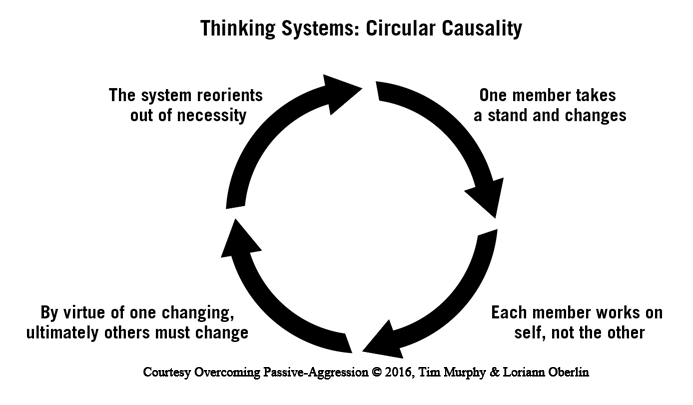
Families don’t function in straight lines. They function in loops.
In family systems work, this is known as circular causality — the idea that behavior within a family is interconnected and mutually reinforcing. One person’s reaction affects another, which affects another, and so on. Over time, these patterns become familiar, automatic, and hard to interrupt.
The graphic above illustrates an important truth: lasting change doesn’t happen by forcing others to change. It happens when one person shifts how they think, respond, or engage. When that happens, the entire system must adjust.
In family counseling, we focus less on who started the problem and more on how the pattern is being maintained. As each family member works on themselves — rather than trying to fix or control others — the system naturally begins to reorganize. New responses create new outcomes. Old roles soften. Tension decreases.
This approach can feel counterintuitive at first, especially for families used to blaming, rescuing, or reacting. But it’s also empowering. It means meaningful change is possible even when not everyone is on the same page yet.
Family counseling provides guidance and support as families learn to step out of old cycles and practice new ways of relating — ones that foster accountability, respect, and emotional safety for everyone involved.
What Family Counseling Focuses On
Family counseling focuses on understanding how individual experiences interact within the larger family system. Our work may include:
Communication
Developing ways to speak and listen that reduce defensiveness and increase understanding
Roles
Exploring long-standing family roles, expectations, and responsibilities that may no longer serve everyone
Boundaries
Establishing healthier emotional and relational boundaries between family members
Emotional Patterns
Identifying recurring reactions such as withdrawal, anger, people-pleasing, or avoidance
Connection
Strengthening trust, empathy, and respect while allowing space for individual differences